
Can We Risk Devotion?
Where are your heroes pointing?

Here's the dilemma: our challenging days require of us a passionate consent, a deep devotion to Something More, big enough to orient our intuitions, enable our courage, ground our compassion and centre local communities — Something or Someone big enough for us to own and express our grief and lament and find ourselves welcomed whether we’re screaming, ranting, despairing or just wanting to be spiritually held so that our feelings don’t tear us apart. But the challenges have also made us distrust devotion.
I’m using the word “devotion” as the integration of a deep, even ultimate, trust with a loyal dedication - in other words, passionately giving myself to that which I trust. The latter phrase may make it easier to see how this fits within my Substack theme (“a compassionate consent to reality”). We find the most courage and resilience in the face of great challenges, when our “consent to reality” is not a grudging, hesitant acceptance but a passionate consent to Reality.1
In our present world, that kind of devotion has had the rug pulled out from under it. Many places where we do see it, we don’t like the look of it because it feels false and manipulated, if not outright harmful or violent. We’re trying to be caring and attentive, but many of us have had so much of our faith deconstructed that we struggle with trusting even the concept of devotion and hesitate to risk offering commitment.
It seems to me that there are also others who have been embedded in stable traditions for generations - say those educated and comfortable (privileged?), with backgrounds in mainline churches - who have long been uncomfortable with strong devotion, preferring mild cynicism and intellectualization to the embarrassment of spiritual fervour. They’ve seen all the failures and disappointments and prefer something safely and respectably agnostic. It’s stable enough for calm lives, just not very inspiring and may not bear all the weight necessary in crises.
I believe it’s devotion that’s desperately needed today,2 a passionate consent strong enough to generate emotional commitment that is determined, that perseveres, yet remains open and joyful. Is this possible? Theories are too dry and causes are too small; ideologies inspire sacrifice one day but prop up tyranny the next. Our devotion must be a flexible and dynamic dedication, enabling us not only to find confidence and conviction in spite of obstacles but compassion for those who who throw those obstacles in our paths and a courageous willingness to engage reality with honesty. Is this possible?
William James, whose Varieties of Religious Experience (based on the Gifford Lectures in 1901-1902) is as insightful now as ever, described devotion as “the hot place in a man’s consciousness” or “THE HABITUAL CENTRE OF HIS PERSONAL ENERGY” (yes, published with all caps!). When a person is converted to a new devotion of this nature, there is an energy that shapes and changes beliefs and behaviours. I know we’re suspicious of words like conversion and salvation and the like, but we certainly need individuals and communities that are transformed and energized around a centre “worthy to give our lives unity and meaning”3 to start re-shaping our society rather than doomscrolling.
I do see a new passion in Minnesota, and in the midst of dark days, this is generating some new light. I’m not talking about the anti-MAGA anger that’s obviously present, but something deeper and more life-giving: mobilized communities sacrificially caring for their neighbours who are under threat — teams of people organizing around offering rides and lunches, and others “bearing witness” at personal risk. These are meaningful actions that open people’s hearts and get their attention so that rural conservative folks are seeing past politics and remembering that they too were immigrants once. They’re recalling that their communities also had roots in mutual aid and support, and many have been asking for ICE to back down. There’s an energy at work that is expansive and not, or at least not primarily, divisive.
How I hope that this energy can live on as part of a large and deep devotion that is not a flash in the pan dissipating into a temporary cause for some and forgotten by many.
These thoughts made me give some attention to how we can keep or feed or choose a devotion big enough to warrant our long term commitment and passion. It’s tempting to say that it needs to be centred on a “living God” who can keep surprising us and holding us accountable, helping us not to settle into something safe, narrow and self-serving.
But I know that associating devotion with God feels challenging for many when we’ve seen human relationship with something loving and divine, meant to be full of awe and mystery, become increasingly thinned and hardened by the misuse for centuries of religious concepts for institutional or patriarchal control. And as we now see, before our eyes and ears, concepts of God getting trampled in the mud for the sake of political manipulation.
As Welsh folk singer, Martyn Joseph, sings on his new album:
In a world that breaks your heart
It's hard to find the higher ground
To keep on keeping on
In a world that breaks your heart
Yes, it’s very hard to find that higher ground.
Then I thought of what’s encouraged me to hold onto my devotion, what “keeps me keeping on” when I get discouraged: I keep looking where my heroes are pointing. I see their character, their examples and their words, but mostly it’s being intrigued by what they’re looking at and listening for and working for.
I could start with common heroes: familiar peacemakers and activists like Gandhi and his experiments for satyagraha4 or Martin Luther King, Jr. and his “beloved community.” There is Oscar Romero’s late conversion to a liberated theology leading to risky preaching for an engaged and compassionate church,5 Dorothy Day’s active response to the “long loneliness” that lifted her sights above the ideologies of the day and enabled her and Peter Maurin to build lasting communities for peace. Or Desmond Tutu who taught a world about forgiveness, ubuntu, and about a shared humanity that is all “made for goodness.”
Important heroes are also among my down-to-earth friends and university professors who have shown me real, inspired lives. Others come from centuries ago like the women and men who lived and died for the religious freedoms and non-violence of the 16th century Anabaptist reformation (my own tradition).6 They may be present day elders like Parker Palmer and Wendell Berry or young women like Valarie Kaur. They may be singers like Bruce Cockburn and Martyn Joseph, poets like Mary Oliver, Andrea Gibson, and Rumi, or novelists like Madeleine L’Engle, Chaim Potok, or Barbara Kingsolver.
I could provide long lists because I want my cast of heroes to be big and diverse: so let’s add therapists like Bonnie Badenoch, Gerald May, and Daniel Siegel; peacemakers like John Paul Lederach, Daniel Berrigan, and Thich Nhat Hanh; the Beguines7; all the monks I’ve mentioned in past posts on contemplation (and add Daniel Berrigan to the mix). Then let’s add Dorothee Soelle, Paulo Freire, and why not Vincent van Gogh and the inspiration at the heart of movies like The Mission and Of Gods and Men. All of these heroes have fed my intuitive confidence of what is good, true and right — and feed my devotion.
These and so many more heroes come from various faith traditions or none. It’s possible they have had private or public weaknesses galore, but they each in their own way still point me faithfully toward a reason for living passionately and compassionately. At the centre of all my heroes is Jesus, and so the words and deeds of my heroes show a leaning toward the poor (“in spirit” or otherwise), toward lives of trust and forgiveness, and toward non-violence as the only viable path to social change. I can be devoted without reserve to what a diverse group of heroes like these point towards, and it matters not to me (theological degree or not) that there is no precise clarity to name that to which they’re pointing or a need for a divine name. This is real enough to help me risk devotion.
I guess I’m suggesting an experiment. Would it help you regain some devotion if you give some thoughts to who your heroes are and where they are pointing? What if you take some time with the words and actions of those who seem truly inspiring (famous and dramatic, quiet and ordinary) even in the midst of our real and heart-breaking world? (And maybe share some examples here!) Let’s help each other “keep on keeping on.”
[This is part of a series of posts exploring a contemplative pathway to healing/maturing that I call “a compassionate consent to reality.” See this post for a summary of the project.
I’m so grateful for your interest and for any comments that you may have!]
Here, as always, I believe the word reality must contain two senses: the everyday reality of our honest, lived experience and the compassionate mystery of Supreme Reality (“God,” if you like) in whom all reality exists. When we think of our “passionate consent to Reality,” it helps to be aware that our trust in a Supreme Reality enables this, but the painful, challenging experiences of reality are all needfully a part of that consent. I don’t believe that we can ever have one without the other.
I also believe that “devotion” usually needs a community and a practice (a ritual) to keep it going.
Phrase from James Fowler (1981) in reference to H. Richard Niebuhr’s insightful writing on ultimate trust (in Radical Monotheism and Western Culture)
Literally, “truth-force” - a philosophy of non-violent resistance.
That cost him his life as he suspected it would.
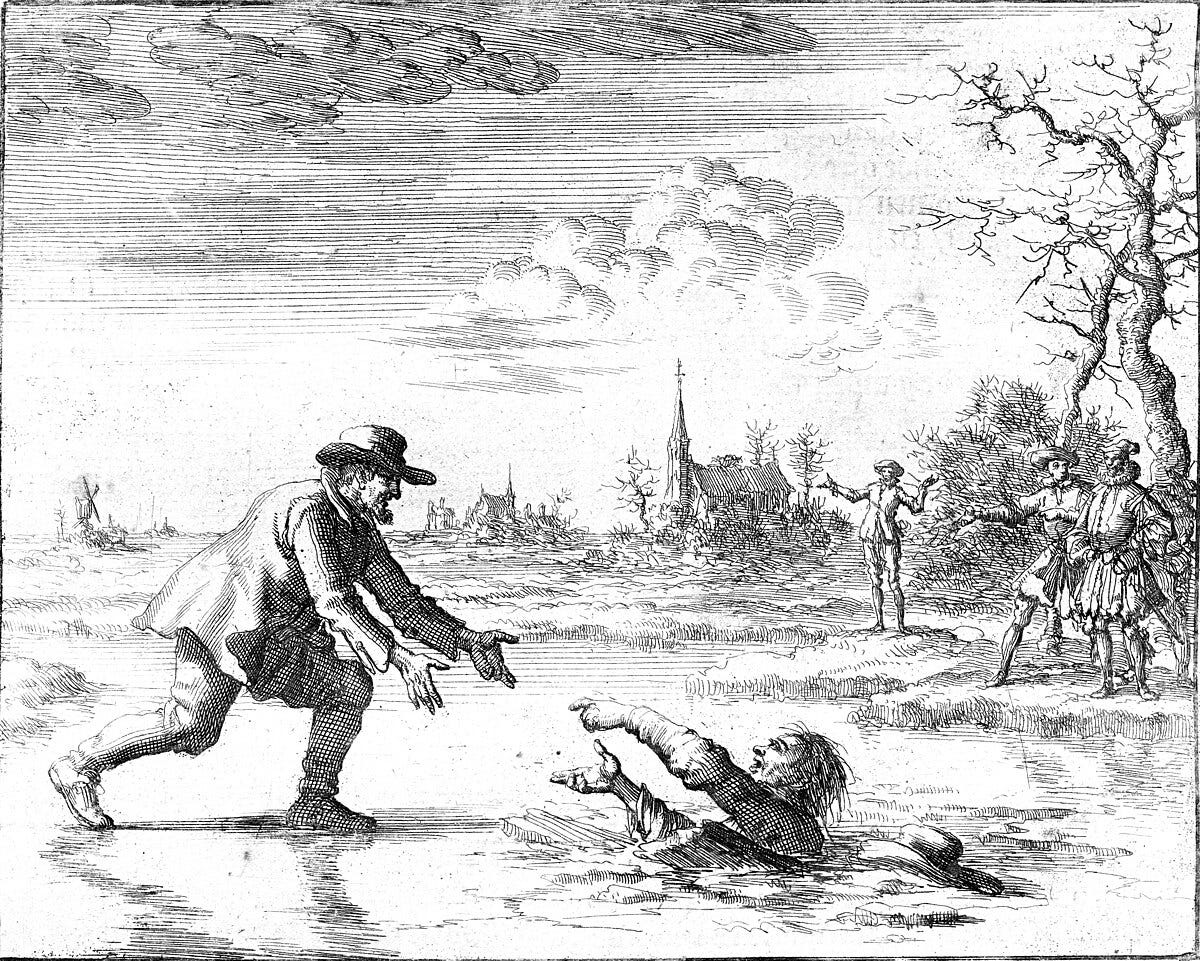
Like Dirk Willems, pictured in the woodcut from Martyr’s Mirror - who saved his pursuer from drowning even though it led to his recapture and death.
A 13th century order of laywomen who formed communities of prayerful devotion that cared for the poor and each other.
Thanks Walter. This is beautiful. I am going to ponder my list of heroes, though many you’ve already named.
Hi Walt, thanks for the morning read and reflective ask. I’ve quite enjoyed your posts. Here are “some” ;) of my heroes that have helped/ help me keep on keeping on. Some more than others.
On noticing, gratitude, reciprocity, gentleness and kindness, and being present to reality (esp helped via nature): Khalil Gibran, Mary Oliver, David Whyte, John O’Donohue, and Rupi Kaur.
On understanding power, power over vs power with and shared, approaching hard things with wisdom and curiosity, the importance of grappling and naming, and understanding intersectionality, equity, justice, and the depths of love: James Baldwin, Bell Hooks, Audre Lorde, Ursula K. Le Guin, Erich Fromm, and Hannah Arendt.
And goodness, openness, and empathy: Martha Nussbaum, Desmond Tutu, and Tennessee Williams.